Glass in the unit
We supply glass to specification: Low-E coated, solar-control, laminated, tempered or patterned.
Technology
Modern insulating glass production requires control of every element: glass, spacer bars, gas, seal, tempering and technical documentation.
Process
WWGLASS posiada automatyczne linie do zespalania szyb jedno i dwukomorowych. Wdrożenie nowej technologii produkcji niskoemisyjnych szyb dwukomorowych jest nieuchronną perspektywą dalszego rozwoju rynku szyb zespolonych, których technologiczne zaawansowanie na rynku maszyn jest najwyższe i gwarantuje długotrwałą eksploatację bez zmiany parametrów jakościowych wyrobu finalnego.
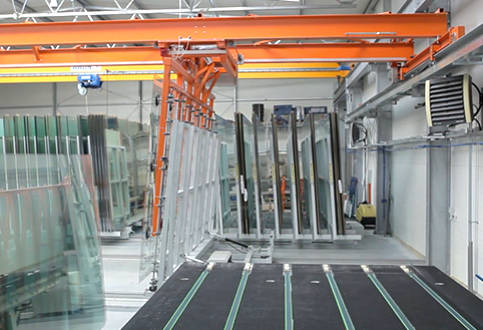
Production
Insulating glass technology relies on controlled stages: from glass and spacer bar, through cavity fill, to sealing and finished unit inspection.
We supply glass to specification: Low-E coated, solar-control, laminated, tempered or patterned.
The spacer maintains the correct gap between panes and affects edge thermal performance — aluminium or warm-edge, as ordered.
The inter-pane space can be filled with air or argon, depending on unit build-up and requirements in the specification.
A primary and secondary seal ensures airtightness — polyurethane or UV silicone, depending on application and edge exposure.
Panes, spacer, gas and seal form the finished unit. Dimensional precision, surface cleanliness and process repeatability matter.
We verify compliance with the specification, seal quality, format and unit integrity before release from production.
Technical knowledge
Articles helpful when designing insulating glass — physical phenomena worth considering at the specification stage.
An acoustic phenomenon in units with internal muntins — causes, conditions and practical design guidance.
Read moreHumidity, temperature and usage conditions — where condensation may appear and what should not be attributed to the glass manufacturer.
Read moreOptical effects in insulating glass — when they may occur and what to consider when specifying the unit.
Read moreStress caused by temperature differences in the glass pane — when risk increases and how we mitigate it in production.
Read moreCharacteristic dark spots and streaks visible on tempered glass through polarised lenses or in photographs — an optical effect, not a glass defect.
Read moreA slight bowing of the pane in a sealed unit caused by temperature and atmospheric pressure changes — when it is normal and when it needs compensating.
Read moreProduction
Modern production and control help us keep repeatable parameters in insulating glass units.